
Why I Compiled These Guides
There's a particular silence that falls in the room after a doctor says the word cancer. I've been in that room twice — twenty-six years apart. This is the story of why I wrote these guides, what they are, and what they aren't.
J.D. Darrah
5/30/20264 min read
There's a particular silence that falls in the room after a doctor says the word cancer. The world keeps moving outside the window. Cars go by. Someone laughs in the hallway. But inside that room, everything has slowed to the speed of your own heartbeat, and you can already feel a thousand questions piling up faster than anyone could answer them.
I've been in that room twice. Twenty-six years apart.
The first time was in 2000. I had kidney cancer. They took the kidney, I didn't need chemotherapy or radiation, and then I had twenty-six quiet years. A quarter century of life going on as normal, sometimes years at a stretch when I didn't think about cancer at all.
This year, that quiet ended. I was diagnosed with two cancers at once: muscle-invasive bladder cancer and prostate cancer. I'm currently on immunotherapy, which is going well — no major side effects so far. In July I'm scheduled for surgery to remove the bladder and prostate, and then more immunotherapy through March of 2027.
I won't say more about my own story here, because this site isn't about me. But I want you to know I've been in the chair you may be sitting in right now. I know what it feels like to hear the word the first time. I know what surviving cancer looks like, and what it looks like when it comes back. I know what it feels like to be told there's a major surgery in your near future, and to walk around carrying that knowledge while still doing dishes and going to work.
In the weeks after this year's diagnoses, I did what most people do — I started looking for information. And I want to say something honestly: there's a lot of good cancer information out there. The American Cancer Society. The National Cancer Institute. Disease-specific organizations like Susan G. Komen, BCAN, and Blood Cancer United. The major cancer centers have excellent patient libraries. Most of what's online is well-meant and useful in its own way.
But none of it quite met me where I was.
The encyclopedic resources gave me everything about what I was facing, which was too much. The breezy patient blogs gave me too little. The clinical guidelines were written for clinicians. The pink-ribbon culture didn't fit my temperament. The personal cancer memoirs were beautiful but described one person's experience, not a map I could use. The "what to expect" articles assumed I already knew what to expect, somehow, from a thing I'd never had to think about.
What I wanted was something more specific. I wanted a guide written by someone who had been where I was — not as a medical authority, but as a fellow traveler — that took me through the first weeks honestly, named the hard things by their actual names, gave me the questions to ask, and walked alongside me through the choices ahead. I wanted it to be specific to my particular cancer, not a generic cancer guide, because the differences between cancers are enormous and the wrong information is sometimes worse than no information.
I wanted it to lead with hope, because hope is grounded in what's actually true about modern cancer treatment for most patients — but to do so without false promises, because false promises break trust the moment treatment gets hard.
I wanted it to acknowledge that the people who love me would be on this journey too, with their own fear and grief and complicated love, and that they would need something separate, just for them.
I wanted it to be free.
I couldn't find that guide for the cancers I was facing. So I wrote them. And then, because I knew other people were sitting in their own version of that quiet room with their own version of the cancer they didn't choose, I wrote more.
---
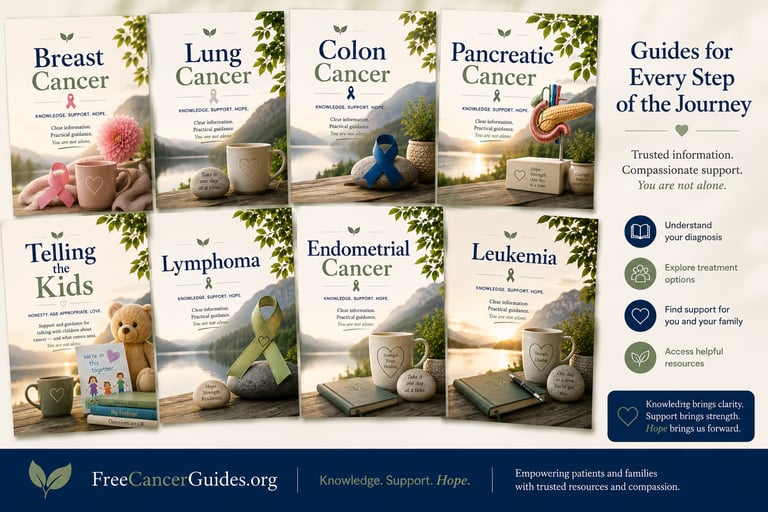
There are now thirteen cancer-specific companion guides on this site — covering breast, lung, colon, prostate, bladder, kidney, stomach, liver, pancreatic, melanoma, endometrial, leukemia, and non-Hodgkin lymphoma. Alongside them is a separate guide for caregivers — the spouses, partners, adult children, parents, and friends walking beside someone with cancer. Two shorter pocket companions focus on the first week after diagnosis and on telling children about cancer in the family. There's a resource page for clinicians who want to share these with their patients.
They are all free to read, free to download, free to print, and free to share. No ads. No email captures. No upsells. If something here is useful to you or to someone you love, take it.
---
A few things to say about what these guides are not.
They are not medical advice. The clinicians who will become familiar faces in the months ahead are the people making your actual treatment decisions; nothing here replaces them. The guides exist to help you talk to your team — to ask better questions, understand more of what you're hearing, and advocate for yourself when you need to.
They are not miracle cures, alternative medicine, or wishful thinking. There's a lot of that on the internet, and I want nothing to do with any of it. Where I describe treatments, they are real treatments backed by real evidence, current as of when I last revised the relevant guide.
They are not promises. Cancer is biology, and biology doesn't read patient guides. Whatever your story turns out to be, it will be shaped by factors no booklet can predict.
They are not pink ribbons, warrior language, or "stay positive" pressure. I have nothing against any of those things for the people who find them helpful, but they didn't fit the kind of voice I needed in my own first weeks, so they're not the voice you'll find here. What you'll find is, I hope, something gentler — a friend who's been there saying here is what helped, here is what didn't, here is what nobody told me.
---
If you've found your way to this site because you or someone you love has just heard the news, I'm sorry. Truly. There is no cleverness that makes this easier. But the road is more walkable than it may feel right now, and you don't have to walk it alone. Take whatever is useful from these guides, share what helps with the people around you, and ignore everything that doesn't apply to your particular story.
You're going to be okay. Maybe not today, maybe not next week. But you are not alone in this. Not for one minute of it.
With love and steady hope,
J.D. Darrah
Medical Disclaimer:
The information on FreeCancerGuides.org is for educational and informational purposes only and is not intended as medical advice, diagnosis, or treatment. Always consult your physician or qualified healthcare provider regarding any medical condition or treatment decisions.
_____________________________________________
Privacy Policy - Terms and Conditions
Copyright 2026 - FreeCancerGuides.org All Rights reserved.
_____________________________________________